The Long Table: What Singapore’s Izakaya Culture Teaches Us About Slowing Down
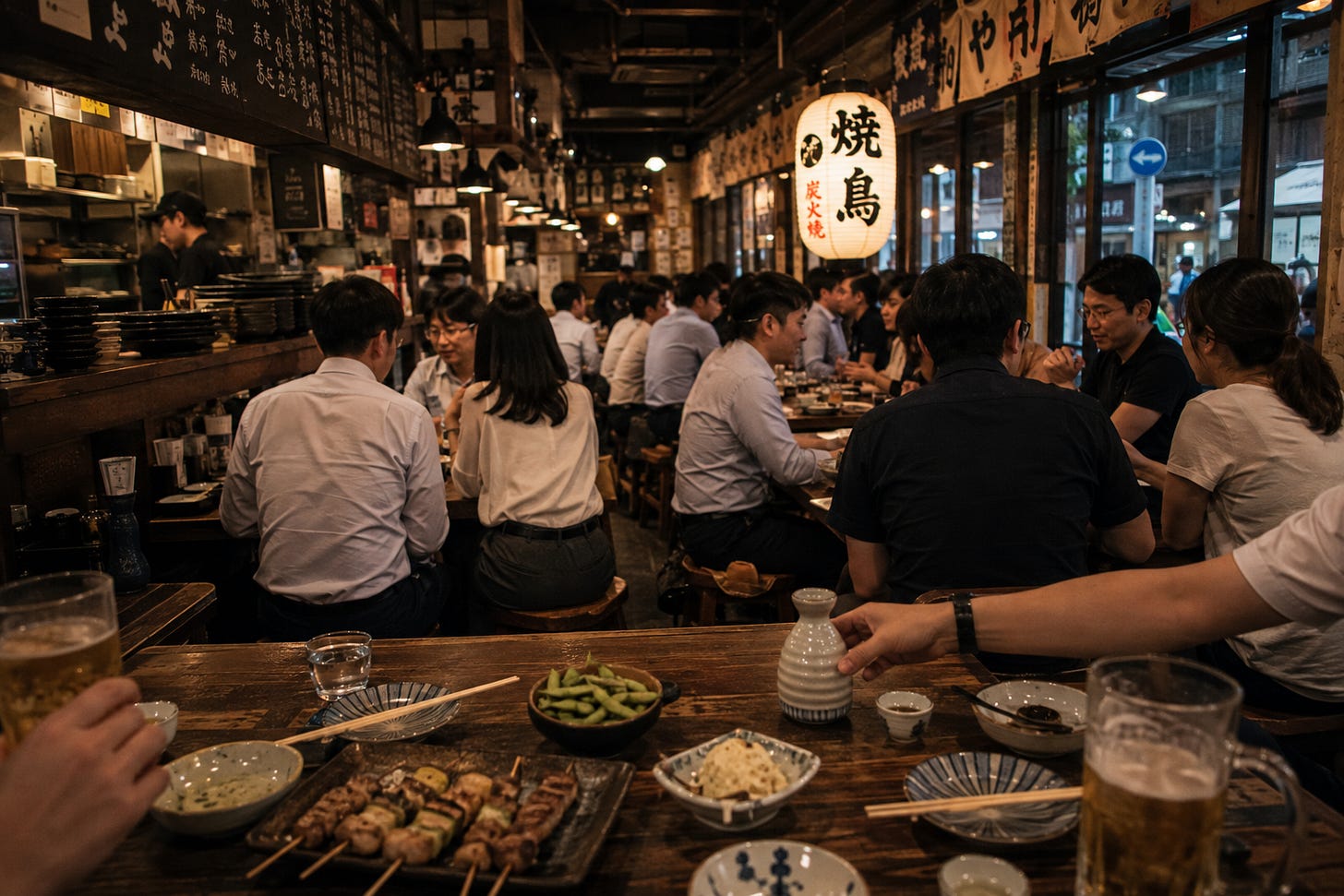
The door slides open and the noise pours out before the light does.
It is a little after nine on a weeknight, somewhere off a side street where the shophouses lean into each other. Inside, the air is warm and thick with charcoal smoke and the sharp, clean smell of grilled skin. A row of skewers turns over glowing coals. Someone calls out an order and the whole counter answers back, a single word, loud and unbothered.
I take a seat at the end of a long communal table. A cold beer arrives before I have finished settling in. Beside me, two strangers argue gently over the last piece of chicken. Nobody is in a hurry to leave. Nobody is performing.
This is the izakaya. Not a restaurant exactly, and not a bar. Something older and warmer than either. If you are new to the concept, this guide is a good place to start before reading on.
I have eaten in silent, ceremonial rooms where every second was measured, and I have loved them. But it is the izakaya I keep returning to when I want to remember what eating together is actually for.
In this post, I want to sit with that feeling for a while. We will look at:
Why the izakaya is a third space, not just a place to eat
How shared plates and slow drinking build real connection
The way izakayas have adapted to Singapore without losing their soul
The quiet craft hiding inside humble food and drink
What all of it teaches about building community
The Izakaya as a Third Space
An izakaya is not somewhere you go to be fed. It is somewhere you go to be among people.
The word itself points to this. I-za-kaya, a place to sit and stay with sake. The staying is the point. You are not passing through on your way to somewhere better. This is the destination, and it asks for nothing except that you settle in.
We have homes, and we have workplaces. The izakaya belongs to the third category, the space between the two, where the guard drops and the day loosens. In a city that runs as hard and fast as Singapore, that third space is not a luxury. It is a release valve.
I think of the office worker who comes in still wearing his lanyard, sheds it into his bag, and by the second drink is telling a story with both hands. Nobody here needs him to be impressive. The room grants a kind of permission that few other places in the city do.
So what? If you build any space where people gather, a café, a team, a home, the lesson holds. People do not relax because you removed pressure. They relax because you gave them somewhere they are not being measured.
Takeaway: Ask what your space asks of the people in it. If it demands they perform, they will never truly stay. Design for arrival, not appraisal.
Shared Plates and the Grammar of Slow Drinking
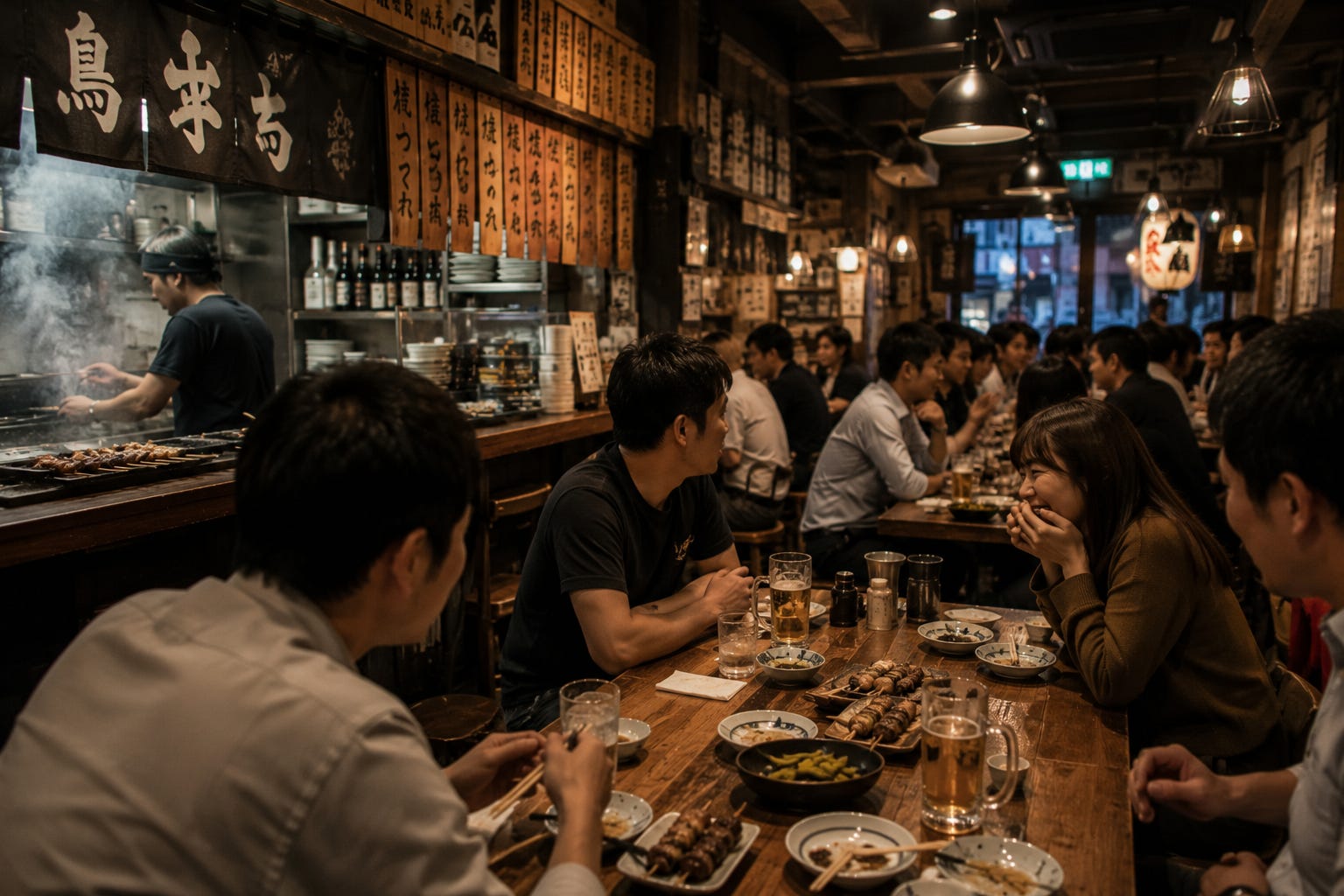
The izakaya has its own rhythm, and once you learn it, you never fully unlearn it.
You do not order a meal. You order a few things, and then a few more, as the night decides. Small plates arrive in waves. Edamame, still warm and flecked with salt. Skewers of yakitori, the fat rendered down and singing. A cold, clean sliver of sashimi. A bowl of something simmered and soft.
Nothing is really yours. Everything sits in the middle, and you reach across for it, which means you have to lean into the person beside you. The food is designed to be shared, and sharing food is the oldest way we have of saying, I trust you enough to eat from the same table.
And the drinking is slow. This matters more than it sounds.
The beer is cold enough to sweat. The sake comes in small pours, meant to be refilled by someone else’s hand, not your own. There is a quiet etiquette to it. You fill your neighbour’s cup and they fill yours. You are never quite in charge of your own glass, and that small surrender keeps you tethered to the people around you.
The pacing is the design. The meal moves at the speed of the slowest conversation. Nothing outruns your hunger. Nothing outruns the talk.
So what? Connection does not happen in a rush. It needs the empty stretches between plates, the pauses where nobody has anything to prove and the conversation drifts somewhere honest.
Takeaway: Next time you gather people, order fewer things and stay longer. Let the meal breathe. The best conversations arrive in the gaps you forgot to fill.
Japanese Soul, Singapore Ground
The izakaya is a borrowed thing, and its honesty lives in how it has changed.
It crossed the sea and landed in a city that already knew how to eat together. Singapore has always understood the long table. The hawker centre runs on the same instinct, strangers elbow to elbow, sharing space if not plates, the food humble and the talk unhurried. The izakaya did not arrive in a vacuum. It found a culture that had been practising its core idea for generations.
So it adapted. You will find an izakaya where the yakitori sits near a plate that has quietly borrowed from satay. Where the sake list makes room for a local craft beer. Where the crowd is Chinese and Malay and Indian and Japanese, all reaching for the same middle of the table.
Here is the balance I find hardest to hold, and the one the izakaya holds well. There is a difference between adaptation and carelessness. One honours the source by understanding it before changing it. The other just takes what is convenient and throws the rest away.
The good version keeps the load-bearing things. The shared plate. The slow pour. The warmth of a room that asks nothing of you. It lets the surface shift while the essence stays intact.
Something can become local without becoming thin. But only if the people running it know which parts were sacred to begin with.
So what? A tradition survives being carried across borders only when someone protects its soul while freeing its surface. That is true of food, and it is true of anything worth passing on.
Takeaway: If you are adapting something you inherited, name its load-bearing parts first. Change the surface freely. Guard the essence fiercely.
The Warmth You Keep Low
I keep thinking about the particular heat of that room.
It is not a bonfire. It is a small fire, low and shared, the charcoal glowing steady under the skewers, the warmth reaching everyone around it and asking only that they tend it together.
There is a kind of power in that shape. Steady rather than sudden. Shared rather than hoarded. Humble enough that no single person owns it. The loud places burn bright and empty out fast. The izakaya lasts the whole evening, because it was never trying to be more than it was.
That, I think, is the thing Singapore’s izakaya culture quietly protects. Not spectacle. Not status. Just the old, durable warmth of people sitting long enough at the same table to remember they belong to each other.
The city outside will always be fast. The lanyards, the deadlines, the trains that never stop moving. The izakaya is the quiet argument that some things are worth slowing down for.
So here is where to begin. This week, find one: off a side street, up a worn flight of stairs, behind an unremarkable door. Go with people you want to know better. Order a few small things, then a few more. Fill someone else’s cup and let them fill yours.
Do not rush the bill. Just stay a little longer.
You might find that the warmest room in the city is the one that asks the least of you.
A related reflection on adaptation (through Japanese curry) is here: Japanese curry and the craft of the adaptable.


Comments
Post a Comment